Knit A Special Baby Blanket with This Diamond Lace Stitch + Video
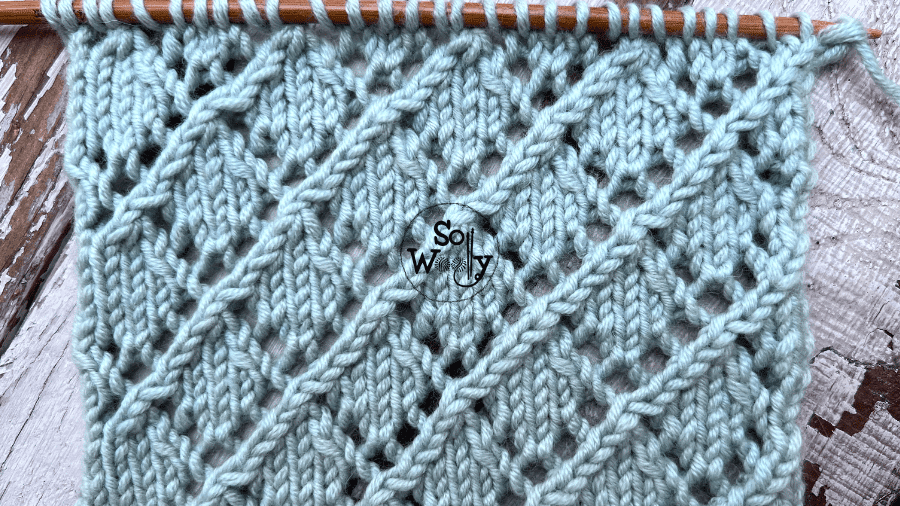
Years ago, I knitted one of my favorite baby blankets using the Diamond Lace stitch, because it’s delicate and elegant.
Whether you’re making a baby blanket, a shawl, a lightweight wrap, or simply testing new lace stitches, the Diamond Lace pattern adds that special touch: soft texture, beautiful openwork, and a timeless geometric design.
And of course, below you’ll see the step-by-step video to guide you through every row.
Let’s get started!
Why You’ll Love the Diamond Lace Stitch
- It’s elegant but not complicated, once you knit the first pattern repeat, you’ll understand it much better 😉
- It’s great for baby stuff, shawls, and summer pieces
- It has the best of two worlds: light, airy while featuring a solid geometric texture
Yarn And Needles
For this swatch I used 100% Merino Superwash wool yarn -worsted weight, medium or nº 4 (super soft, great for baby projects) #ad
And US 7 – 4.5 mm needles. This is one of my favorite bamboo needles sets with case: it comes with 18 sizes (they’re are not too long not too short), light, warm, not slippery, great for beginners #ad
“As an Amazon Associate, I earn from qualifying purchases.”
What You Need to Know About Lace Patterns
Before starting a new project, I’d suggest you to take a look at this “Lace Knitting Guide” that I wrote some months ago, with my best tips to succeed every time you want to knit something using a lace pattern.
So, if you like this diamonds lace stitch and would love to make a garment with it, go check that info first 😉
Abbreviations
CO: cast on
st: stitch
sts: stitches
RS: right side of the work
K: knit
P: purl
yo: yarn over (bring the yarn over the needle to create a hole)
k2tog: knit two stitches together (a simple decrease)
k3tog: knit three stitches together (a double decrease)
sl1kw: slip one stitch knitwise (pass it onto the right-hand needle as if to knit)
psso: pass the slipped stitch over
BO: Bind off
WS: Wrong side of the work
Pattern Notes
- The odd rows form the right side of the work.
- For a nice edge, slip the first stitch as if to purl and knit the last on every row.
- The cast on row shouldn’t be too tight; if you’re using the Long Tail cast-on method, use two needles at a time (in case you can’t control the tension). I’ll show you in the video how to do it.
How to Knit the Diamond Lace Stitch
Stitch Multiple
CO multiples of 6 + 3 + 2 (edge sts); i.e.: 6 * 3 = 18 + 3 = 21 + 2 = 23 sts.
Row-by-Row Instructions
Row 1 (RS): wyif sl1pw, K5, k2tog, yo, *K4, k2tog, yo*. Repeat from * to , to last 3 sts, K2, K1 (edge)
Row 2 and every even row: P across
Row 3: wyif sl1pw, K1, *yo, sl1kw, K1, psso, K1, k2tog, yo, K1*. Repeat from * to , to last 3 sts, yo, sl1kw, K1, psso, K1 (edge)
Row 5: wyif sl1pw, K2, *yo, k3tog, yo, K3*. Repeat from * to , to last 2 sts, K1, K1 (edge)
Row 7: wyif sl1pw, K2, *k2tog, yo, K4*. Repeat from * to , to last 2 sts, K1, K1 (edge)
Row 9: wyif sl1pw, K1, *k2tog, yo, K1, yo, sl1kw, K1, psso, K1*. Repeat from * to , to last 3 sts, K2, K1 (edge)
Row 11: wyif sl1pw, k2tog, yo, *K3, yo, k3tog, yo*. Repeat from * to , to last 2 sts, K1, K1 (edge)
Row 12: P across
Repeat rows 1 – 12 until the desired length is reached.
When finished, BO purlwise after row 11 (WS).
This is the other side of the work:
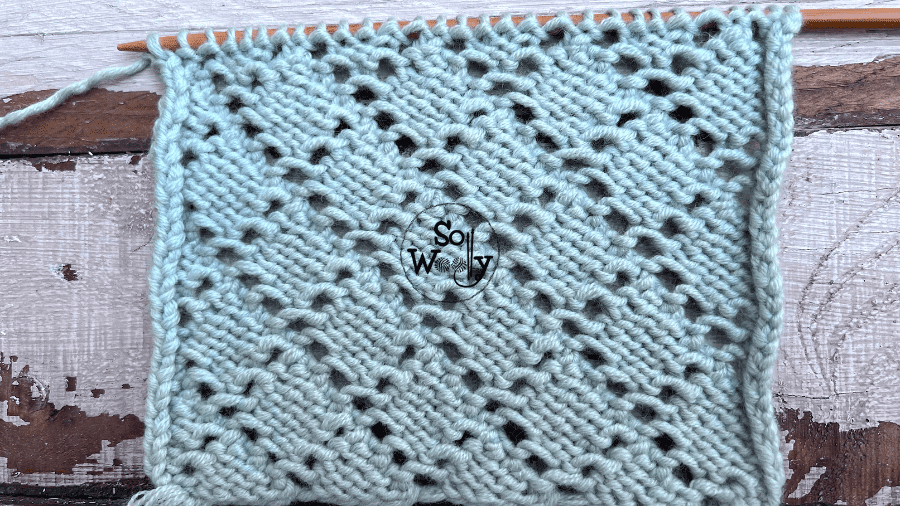
Diamonds Lace Stitch: Variations & Customizations
- When knitting a blanket or a sweater, create alternating diamond panels
- Or combine the diamonds lace stitch with stockinette sections
- Use gradient or pastel yarns for baby blankets 🙂
Common Questions
Is this good for beginners?
Yes — as long as you’re comfortable with yarn overs and simple decreases.
Does it curl?
It does; if you are thinking of knitting a blanket or any other piece that should stay flat, add a Garter edge (they look lovely together).
Can I use it with chunky yarn?
Yes, but the lace effect will be more subtle.
Diamonds Lace Stitch Knitting Pattern Step By Step
💌 Before you go… Join the So Woolly Community!
Subscribe to my list below ⤵️ and get unique patterns, tips, and tools that make knitting easy 😉