How to Knit the Garter Lace Stitch: Easy 2-Row + Video
Meet the Garter Lace Stitch — and prepare to fall a little bit in love 😊
✨ Prefer a printable version without ads or scrolling?
👉 You can download the printable PDF here →
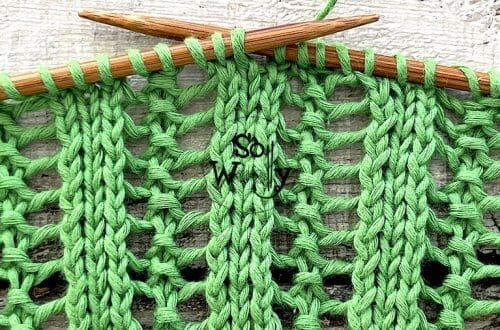
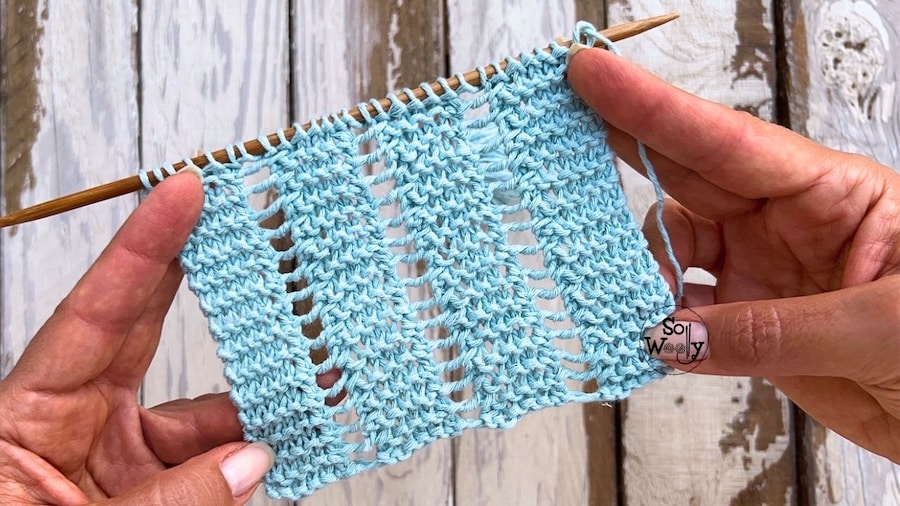
It is one of those patterns that looks far more impressive than it is to knit. Just two rows. And the result? An airy, delicate fabric with a beautiful texture that makes you want to cast on immediately.
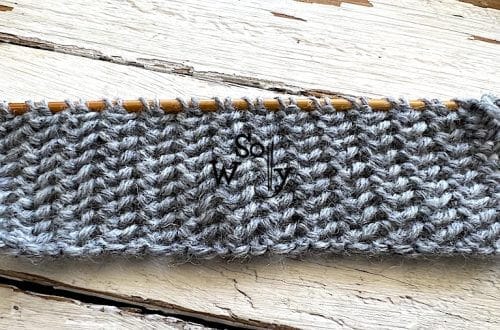
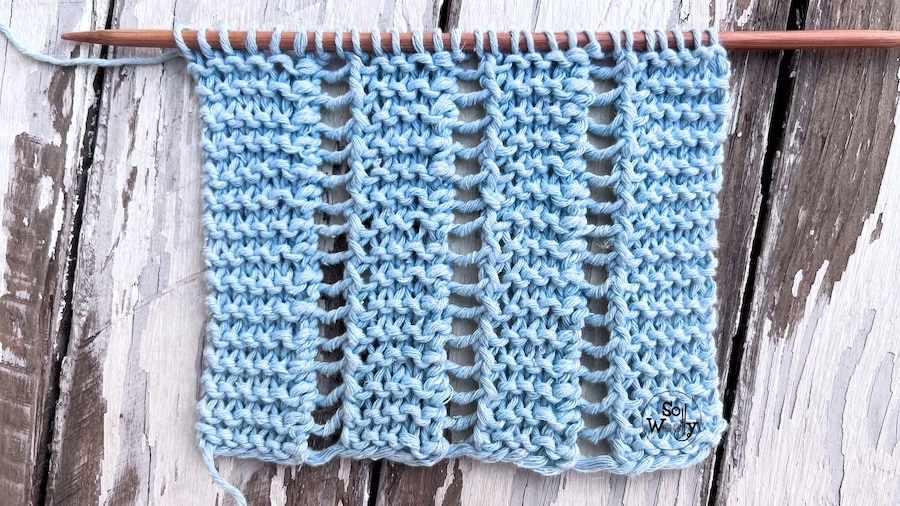
But here’s what makes this one truly special: it lays completely flat AND it’s identical on both sides.
If you’ve ever knitted an openwork pattern only to watch the edges curl up in protest — you know how rare that combination is. With the Garter Lace stitch, that problem simply doesn’t exist 😊
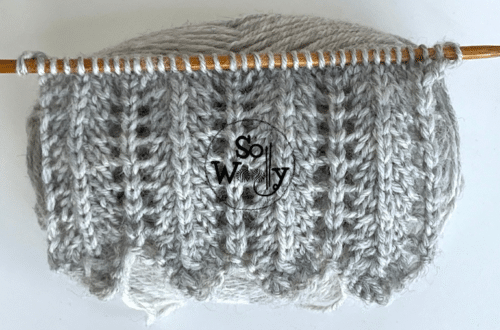
The fabric is formed by columns of garter stitch joined by delicate bands of openwork — structured enough to feel substantial, airy enough to feel light and seasonal. And because both sides look exactly the same, it works beautifully for any project where the “wrong side” is visible.
It’s also one of those stitches that clicks into rhythm fast — intuitive, quick to memorise, and genuinely fun to knit. Easy, yes. But never boring.
Grab your needles and let’s get busy!
Materials
For this swatch I used:
US 7 (4.5 mm) bamboo needles (they’re long, smooth, and pointy, perfect for all sort of patterns) #ad
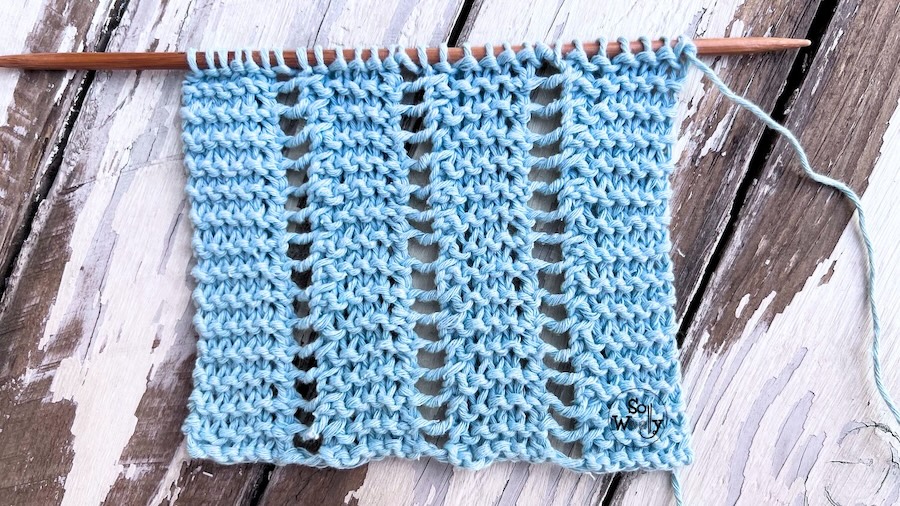
And a blend of 50% cotton & 50% polyester (DK weight, breathable, structured, and has high durability) #ad
“As an Amazon Associate, I earn from qualifying purchases.”
Abbreviations
CO: cast on
st (s) = stitch (es)
RS: right side of the work
K: knit
k2tog: knit two stitches together
dyo: double yarn over. Wrap the yarn twice over the right-hand needle
ssk: slip, slip, knit. Slip the first stitch as if to knit, slip the second as if to knit, put both back onto the left-hand needle, and knit them together
P: purl
WS: wrong side
BO: Bind off
How to Knit The Garter Lace Stitch Pattern
Stitch Multiple
CO multiples of 7. For example: 7 * 3 = 21 sts (no edge sts included).
Garter Lace Stitch Knitting Pattern Instructions
Row 1 (RS): K5, *k2tog, dyo, ssk, K3*. Repeat from * to *, to last 2 sts, K2.
Row 2: K7 (the seventh stitch is knitted using the first loop from the double yarn over, leave the second loop on the needle), P1 (purl into the second loop from the double yarn over), *K6 (the sixth stitch is knitted using the first loop from the double yarn over, leave the second loop on the needle), P1 (purl into the second loop from the double yarn over)*. Repeat from * to *, to last 6 sts, K6.
Repeat rows 1 – 2 until the desired length is reached.
How to Bind Off
When finished, BO knitwise after row 2 (RS).
WHERE TO USE THIS STITCH 🧶
The Garter Lace stitch is an hybrid between a textured pattern and openwork, so it’s wonderfully versatile. Here’s where it really shines:
Scarves — the flat edges and reversible fabric make it a dream for scarves. No borders needed, no worrying about the “wrong side” showing. Just cast on and go.
Wraps and shawls — the airy, open fabric drapes beautifully in lightweight yarn. Perfect for a seasonal wrap or rectangular shawl.
Seasonal blankets — the openwork adds lightness to a blanket without sacrificing warmth. Lovely in cotton for a summer throw or light wool for an autumn lap blanket.
Shrugs and vests — because both sides are identical and the fabric lays completely flat, this stitch works beautifully for simple garments where structure matters.
Not sure how many stitches to cast on for your project? Check out my Guide to calculating stitches, yarn and measurements for any rectangular project — it takes the guesswork out completely!
Tips For Knitting The Garter Lace Stitch Pattern
1. Don’t be afraid of the double yarn over: it’s simpler than it looks — just bring the yarn forward between the needles twice before working the next stitch. That’s it! The yarn over is what creates those beautiful eyelets.
2. Count your stitches after the first few rows: lace is fun once you’re in the rhythm, but it’s worth double-checking your stitch count at the beginning until the pattern clicks.
3. Choose your yarn wisely: smooth yarns show off the openwork beautifully — wool, cotton, linen and their blends all work wonderfully. Avoid very fuzzy yarns which will hide the delicate eyelets.
4. No blocking needed — but it helps: because this stitch lays flat naturally, blocking isn’t essential. But if you do block it, you’ll see the openwork open up beautifully and the fabric relax into its full potential.
5. Rule of Thumb: knit a small swatch before starting a larger project.
This is the other side of the work:
Free Scarf Planning Guide
If you’d like to turn this stitch into a scarf, my free 3-Step Perfect Scarf Formula is a great place to start.
It includes how to choose your yarn, how to pick the stitch pattern, how much yarn you’ll need, needle sizes, and cast-on numbers for 2 different yarn weights.
👉 You can download the free full guide here →
Frequently Asked Questions
Is this stitch pattern reversible?
Yes, it looks identical on both sides, which makes it a perfect reversible stitch pattern for scarves, blankets, baby items, and any project where both sides will be visible.
Does this stitch curl at the edges?
No, it lays flat; this is why is great for the projects described above.
Is this stitch pattern beginner-friendly?
I’d say it’s an introduction to lace knitting, perfect for advanced-beginners. It features the 3 most used lace techniques (yarn over, ssk and k2tog) in a no-complicated way. Try it first knitting a swatch, and you’ll be confident to start a bigger project.
How many stitches do I need to cast on for this stitch?
Cast on a multiple of 7 (no edge stitches included). For example, to make a small sample, you could cast on 11 stitches (7 × 4 = 28).
Where can I find help planning a scarf with this stitch?
If you’d like to turn this stitch into a scarf, my free 3-Step Perfect Scarf Formula walks you through yarn selection, stitch choice, needle sizes, and cast-on numbers for two different yarn weights.
Do you have a printable version of this Garter Lace Stitch Pattern?
Yes. If you prefer a clean, printable version without ads or scrolling, you can download the PDF file here. That PDF is perfect for keeping in your project bag or printing for easy reference.
Before you Leave: Join the So Woolly Community!
If you enjoyed this tutorial, join me for personal notes, thoughtful lessons, and calm knitting guidance — delivered straight to your inbox.
No overwhelm. No pressure. Just clarity and steady progress.
A big hug, and happy knitting 😊
Carolina – So Woolly
PS: If you love knitting stitch patterns that don’t curl, check my guide → 15 Knitting Stitches That Don’t Curl