How to Knit the Quilted Slip Stitch: Soft & Easy + Video
This quilted slip stitch knitting pattern is worked over just 4 rows and uses only knit stitches, purl stitches, and one simple slipped stitch technique.
✨ Want to knit this without ads or scrolling?
👉 Click on this line if you want to download the printable PDF pattern
Once you’ve worked through the first repeat, the pattern becomes super easy.
Prefer to see the stitch in action?
I’ve prepared a video tutorial showing you exactly how to work this 4-row quilted slip stitch pattern, including the slipped stitches and how the texture develops as you repeat the rows.
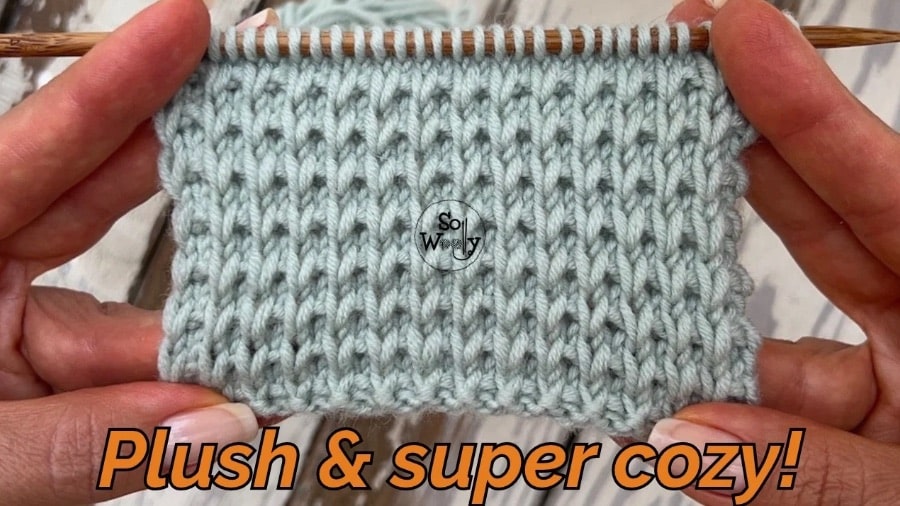
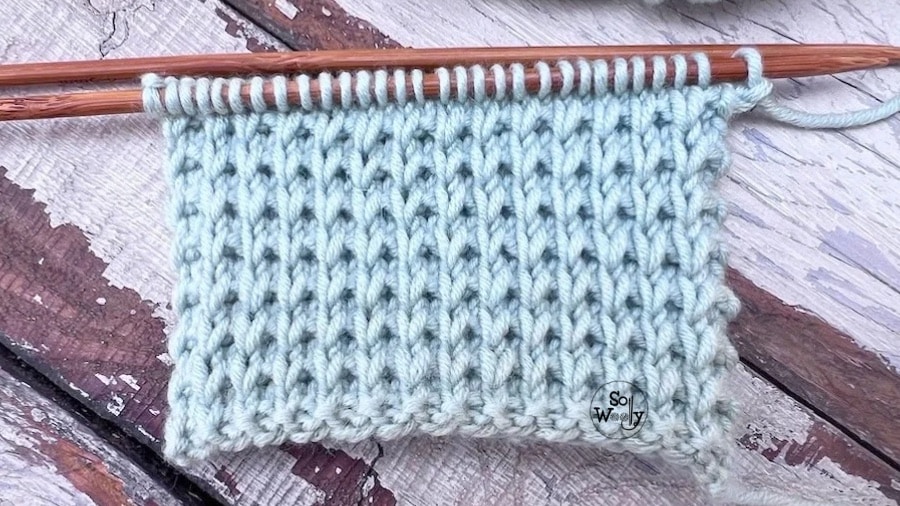
The result is a soft, slightly spongy fabric with a lovely three-dimensional texture. The little squares add a cute detail, while the raised columns created by the slipped stitches give the fabric an almost double-layered appearance.
And the best part?
There’s no complicated stitch manipulation involved.
Just slip a few stitches, knit and purl, and let the texture do all the work.
A Cute Quilted Slip Stitch for Autumn & Winter Knitting
I particularly like this stitch for the colder months.
The texture has that soft, cozy quality that works beautifully with wool, wool blends and other warm yarns. It’s not overly bulky, but it has enough dimension to make a simple knitted fabric feel substantial and interesting.
You could use it for:
- scarves
- cowls
- hats
- blankets
- baby blankets
- sweaters
- cardigans
- cushions
- winter accessories
- and other projects where you want a little extra texture without a complicated pattern
The stitch would also make a lovely panel combined with a simpler stitch, especially when you want the textured section to stand out.
Why I like this Quilted Slip Stitch Knitting Pattern
There are a few little things going on here that make this pattern especially charming.
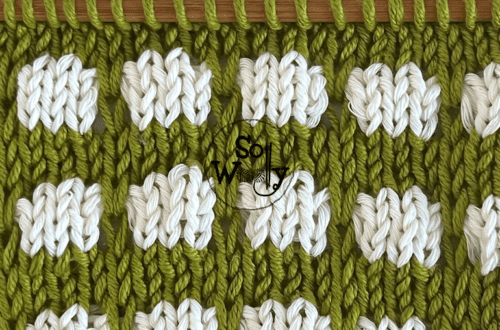
First, you have those mini square shapes sitting inside the repeat. They give the fabric a playful, almost quilted appearance.
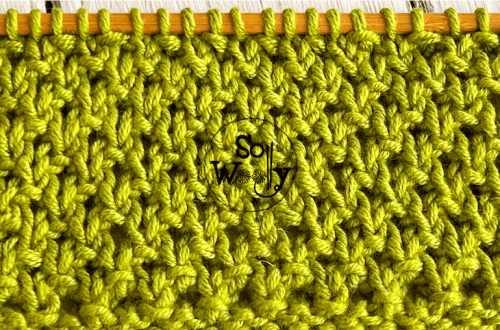
Then there are the raised vertical columns of V-shaped stitches created by the slipped stitches. These sit slightly above the rest of the fabric and give the pattern its wonderfully dimensional look.
The result is a fabric that feels soft and a little spongy under your fingers.
It’s one of those stitches where you can look at the finished fabric and think, “Oh, that’s going to be too complicated.”
Luckily, it isn’t. 😉
Slipped Stitches: The Good, the Bad & the Beautiful
One of the things I particularly enjoy about this quilted slip stitch pattern is that the texture comes from something so simple: slipped stitches.
When you slip a stitch, you’re simply moving it from one needle to the other without knitting or purling it. Nothing complicated. No special maneuver. Yet that little pause in the stitch’s journey can create some adorable effects.
Here, the slipped stitches are what give us those raised columns. They sit on top of the fabric and create that lovely embossed effect, which is part of what makes the fabric feel so soft and squishy.
And there’s another advantage: slipped stitches can make your knitting more economical.
You’re not performing a knit or purl on every stitch. Sometimes, you’re simply moving a stitch across and carrying on. Fewer movements can mean a quicker rhythm, especially once you’ve repeated the pattern a few times and your hands know what’s coming next.
That’s one of the reasons I think slipped stitches deserve more attention. They can give us a lot of texture without making us work particularly hard for it.
Not so hard that you tighten the stitches — just enough to take up that little bit of excess yarn so everything sits neatly and evenly.
But there’s a little catch…
Slipped stitches can have a downside too.
Depending on the design, they can pull the fabric slightly and make it want to bend or pucker. And they can sometimes make the side edges look a little irregular.
That’s why the right border matters.
For this particular stitch, I like a 1×1 rib border on each side. It gives the edges some structure and helps keep the fabric looking neat and flat.
And one more thing: when you’re slipping a stitch, don’t pull the yarn too tightly. Give it enough room to sit naturally. Those strands need a little freedom so they don’t fight against the rest of your fabric.
✨ Want to knit this without ads or scrolling?
👉 Click on this line if you want to download the printable pattern (PDF file)
Why a Structured Border Matters When Knitting the Quilted Slip Stitch
Slipped stitches can create tension throughout the fabric. And when the main stitch pattern has that kind of pull, the borders need to be stronger and more structured than the fabric itself.
This is where a short knit-and-purl pattern can make a big difference.
A border made with a frequent interchange of knits and purls creates a compact, structured edge that helps keep the fabric cohesive and uniform. The shorter the repeat, the more consistently the stitches support one another, which gives the edge a little more stability.
That’s why I like a 1×1 rib for this particular stitch. The alternating knit and purl stitches create a firm, even border that works beautifully with the softer, more dimensional fabric in the middle.
In other words, don’t think of the border as just a decorative finish. It’s part of the architecture of the piece.
When your main stitch pattern has a tendency to pull, a well-structured border helps keep everything where it belongs: flatter, neater and more cohesive.
And this is something worth remembering beyond this particular stitch: the more tension and movement your stitch pattern creates, the more structure your borders may need.
Materials
For this swatch I used:
US 7 (4.5 mm) bamboo knitting needles (this set comes with 18 pairs, case and useful accessories) #ad
And 100% Merino wool yarn (smooth, soft, structured and machine washable) #ad
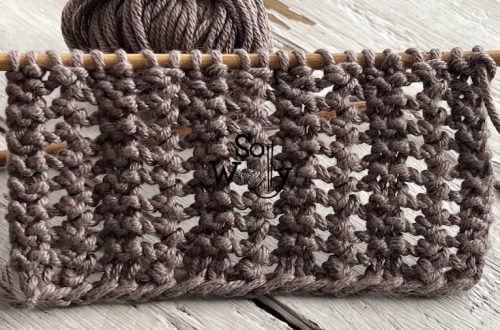
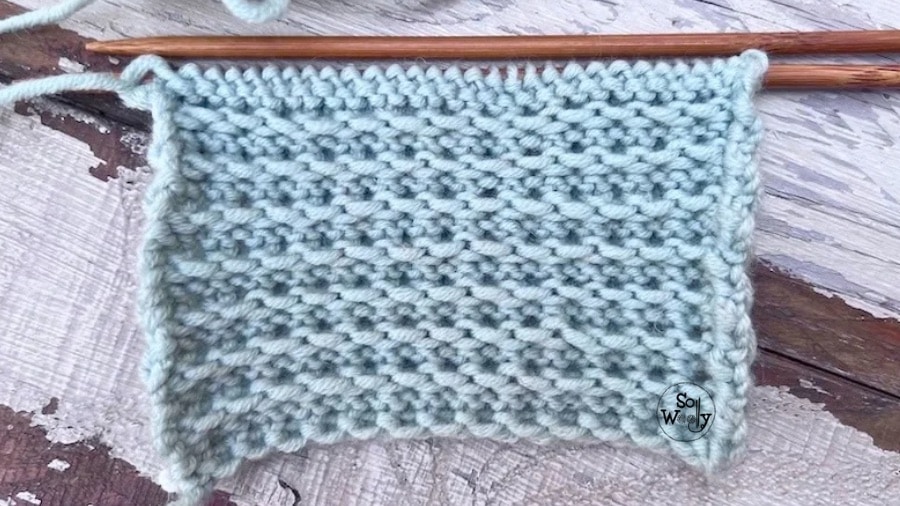
This is the other side of the work:
“As an Amazon Associate, I earn from qualifying purchases.”
Abbreviations
CO: cast on
st (s) = stitch (es)
RS: right side of the work
wyib: with yarn in back
sl1pw: slip one stitch purl-wise (pass it onto the right-hand needle as if to purl)
wyif: with yarn in front
K: knit
P: purl
WS: wrong side
BO: Bind off
How to Knit This Quilted Slip Stitch
Stitch Multiple
CO an even number of sts.
For example: 12, 28, etc. (this number includes 2 edge/selvedge sts).
Instructions
Row 1 (RS): K1 (edge), *K1, wyib sl1pw*. Repeat from * to * to last st, K1 (edge)
Row 2: P1 (edge), *wyif sl1pw, K1*. Repeat from * to * to last st, P1 (edge)
Row 3: K across
Row 4: P across.
Repeat rows 1 -4. When finished, BO knit-wise after row 2 (RS).
More Slip Stitch Knitting Patterns to Try
If you’ve enjoyed the texture created by this quilted slip stitch, don’t stop here!
Slipped stitches can be used in many different ways: to create raised textures, geometric patterns, vertical columns, stripes and even colourwork effects without having to work with several colors in every row.
Here are some more of my knitting patterns that use slipped stitches:
Alternating Slip Stitch Pattern
My Final Thoughts
I love stitches like this because they remind us that fascinating knitting doesn’t have to mean complicated knitting.
Sometimes a simple slipped stitch, repeated in the right place, can completely transform an ordinary piece of fabric.
And once you learn the steps, you can stop thinking about every individual stitch and simply enjoy watching those little columns and soft squares appear.
That’s my favourite kind of knitting: simple enough to relax with, interesting enough to keep you motivated.
💌 Before you Leave: Join the So Woolly Community
If you enjoyed this tutorial, join me for personal notes, thoughtful lessons, and calm knitting guidance — delivered straight to your inbox.
No overwhelm. No pressure. Just clarity and steady progress.
A big hug, and happy knitting,
Carolina – So Woolly
PS: You can explore more designs like this in the Textured Stitch Patterns collection.